My First Course
- Read
- 10 min
- Planted
- 2023.09.10
- Last tended
- 2026.04.17

Goal Area: Earn $1 Online
Notebook: Course Creation Challenge
My Niche
User Experience Research (UXR)
Articulate Your Value
I help UX Researchers design their studies so that they can deliver impactful insights to their teams unlike wasting resources answering the wrong questions because my process starts with a decision, not research.
Topic Area
Selecting the best methods for UX Research studies
PODs
Points of Discovery are:
- Specific
- Unique
- Timely
Example PODs
Reference: https://program.reforge.com/programs/user-insights-eg
- How to add enrich your insights no matter how scrappy your project
- The 4-step method to go from project kick off to research-ready instantly
- How to instantly identify the right methodology for any research problem
- The X Method for scoping any research project
- The X Flow for collecting the right data for your study
- How Decision-First Planning instantly drives impacts to your team
- The X-step ritual that landed me a big tech job
- My blueprint to take any research finding from ambiguous to actionable
- How to drive impact no matter how small your study
- How the Decision-First Approach flips your research process to
- How the Decision Matrix sizes requests so that you prioritize the right research
- My Method Matrix to identify which methods have the strongest fit with your evidence needs
- Build Research Plans that
- My Research Plan clearly scopes the evidence, methods, and outputs needed to steer your study in the right direction
- The 12 best methods pro researchers use for any phase of development
- How to select the best methods for any phase of development and research with confidence
- 5 strategies to increase research fidelity to achieve higher decision-making confidence
Course Title
Course Outline
Introduction
Three things the audience needs to understand after taking your course
- Decision-First Research puts UXRs in the best position to answer the right research questions
- Research Plan scopes the evidence, methods, and outputs needed to start with confidence
- Method Matrix identifies which methods have the strongest fit with your evidence needs
Myth-Busting
- You need research and evidence before you can make a decision, however, you risk…
- Gathering the wrong data
- Taking the wrong approach
- Not involving the right stakeholders
- UXR is too expensive, time-intensive, and a blocker (link)
- It’s expensive to not do research and be wrong
- Research doesn’t have to be slow or block development with proper planning
- You only need surveys, interviews, and usability tests to do research (link)
- Convenient methods can limit findings and their impact
The Mechanics
-
Step #1: Identify the Decision-First Approach
- Define the decision
- Map out the evidence
- Plan the approach
- Second half will be another course
- Execute on approach
- Synthesize the data
- Make the decision
-
Step #2: Define the Decision
- What is and isn’t a decision
- The impact of a decision on research
- Information we gather
- Users we engage and how
- Stakeholders we involve
- Why it’s important to begin with the decision
- Map the stage of development (assumptions)
- The stages of development
- Discovery: identify the problem and audience
- Design: defining the constraints and components of the solution
- Develop: executing and sequencing, when to launch
- Deploy: evaluating solution after launch
- How decisions build on each other and create assumptions to test
- Product scoping to product launch
- 3 Principles
- most teams move from left to right through the stages over time
- teams often loop back from the deploy stage to one of the other stages as they iterate on their feature or product
- as you move from discovery to deployment, your decisions begin to tree out over time and you narrow your focus on one branch of that tree
- Stage Development Diagnosis Toolkit - set of 4 diagnostic questions that will help you uncover the assumptions that exist, and stress-test your confidence in them
-
Discover: Do you have a well-defined user problem? If yes, go to Design
- You don't have a well-defined problem, or are having trouble stating the problem
- You have a problem but have outstanding questions about it
Specific questions
- What is the scope of the problem you're trying to solve?
- What customer or users have this problem?
- Why do they have this problem?
- How urgent or severe is it?
- How much would they value having the problem solved?
- How else do they solve this problem today?
- How good or bad are these alternates?
- How big is the market or opportunity for this problem?
- How does it compare to other problems you could solve?
-
Design: Do you know how you're going to solve the problem? If yes, go to Develop
- You know what problem to solve, but don't know how to solve it
- You have some solution ideas, but need to refine and prioritize them
- Helps to structure milestones and prioritize functionality and elements when we're developing
Specific questions
- Do you know what features, elements or functionality will enable users to solve their problem?
- Do you know which ones users will value most and least?
- Do you have a prioritized list of functionality and elements based on what users value?
- Do you have a strong hypothesis of how your solution should look?
- Do you know which elements of your solution need more work, and which ones you're most confident about?
-
Develop: Do you know if your solution is usable and valuable for the target audience? If yes, go to Deploy
- Ensures we launch valuable products and features
Specific questions
- Does the solution work in isolation?
- Can users perform the tasks and actions that your solution is built to enable?
- Does the solution work in the product?
- Can users find it?
- Can users use it?
- Where are the biggest issues or problems with your solution?
-
Deploy: Do you know how well your solution is working in the real world?
Specific questions
- Does your solution perform as you expected?
- How does it impact your strategic objective?
- How do users feel?
- How are they behaving, and do they feel like it solves the problem you built it to solve?
- How could you improve your solution’s performance or level of satisfaction?
- Do you know what is next for this solution?
-
- The stages of development
- The splash zone (magnitude) of the decision
- What is the splash zone
- Dimensions of a decision’s splash zone
- Work required - when big/small projects work best
- Stakeholder involvement - involving leadership for large projects
- User impact - who does this decision affect
- Common decision making mistakes
- jumping ahead of decisions
- wasting resources on decisions that were already made
- incorrectly sizing research based on decision magnitude
-
Step #3: Map out the Evidence
- Decision-evidence fit means having the right evidence to inform the decision you're trying to make
- Two common mistakes with gathering evidence
- Too much evidence
- Evidence for the wrong audience
- leads teams to default to research methods that are tried-and-true, versus the ones that help inform the decision most effectively
- Avoid common mistakes with
- Understanding the different research methods and their capabilities
- Two characteristics of evidence
- Types of Responses: Qualitative v. Quant
- Qual
- Quant
- What Responses Reveal: Attitudes v. Behaviors
- Attitudes
- Behaviors
- Types of Responses: Qualitative v. Quant
- This 2x2 matrix helps us create four types of research archetypes based on the evidence each creates
- Q1: QL-AT (Conversational) most common
- What it is
- Methods
- Q2: QN-AT (Survey) most common
- What it is
- Methods
- Q3: QL-BE (Observational) done by dedicated research teams
- What it is
- Methods
- Q4: QN-BE (Testing) most common
- What it is
- Methods
- Q1: QL-AT (Conversational) most common
- Two characteristics of evidence
- Thinking ahead to the output you want to create to inform your decision
- draft a mockup of the output you want to create
- you can validate that your chosen method will work to get the data you need for the output
- you can tailor your method to best collect the right data
- draft a mockup of the output you want to create
- Understanding the different research methods and their capabilities
- We can define research methods based on the evidence they create
-
Step #4: Plan the Approach
- Mapping Decision Stage to Evidence Needs. First, we'll look at key evidence to create with your research, based on your stage of development on the decision matrix
- Discover
- Problem Identification: What problems do users have? Which users?
- Problem Understanding: Why do users have these problems? What is the problem scope? How frequent or intense is it? What do users think about this problem, and how do they solve it today? How are those solutions working? How much do users value having this problem solved?
- Problem Prioritization: How big is the market for this problem? How does this problem rank compared to other problems that we could be solving? How does this problem leverage our capabilities and skill sets?
- Design
- Solution Ideation: What are possible approaches to solving this problem?
- Solution Design: What solution features or elements will users value?
- Solution Validation: Does my solution design work if used correctly? What elements do or don't work?
- Develop
- Solution Usability: can users do what you want & expect them to do?
- Solution Discoverability: can users find the solution in context of the broader product experience?
- Solution Value: does the solution create value for users in the broader product experience?
- Deploy
- Solution Performance: How does my solution impact key product metrics?
- Solution Disruption: Are there any unintended consequences to other product metrics or the overall user experience?
- Solution Satisfaction: Are users satisfied with the solution? Why or why not?
- Your first step is to understand what evidence needs are of highest priority for you based on the stage of your decision
- You can start your research plan by describing what evidence needs you have, based on the stage in your research planning template.
- Discover
- Mapping Methods to Evidence Needs. Next, we'll look at research methods that are most effective at creating the evidence.
-
Top Down v. Bottoms Up Approach to Research Method Selection
- Top down
- lead to situations where you do a lot of research, but don't have a lot of insight from that research that helps inform your decision.
- Bottoms Up
- we recommend taking a more bottoms-up approach; start by looking for what research methods create the best evidence for your particular need.
- Then you think through what constraints you have as an organization.
- Top down
-
Evidence-method fit
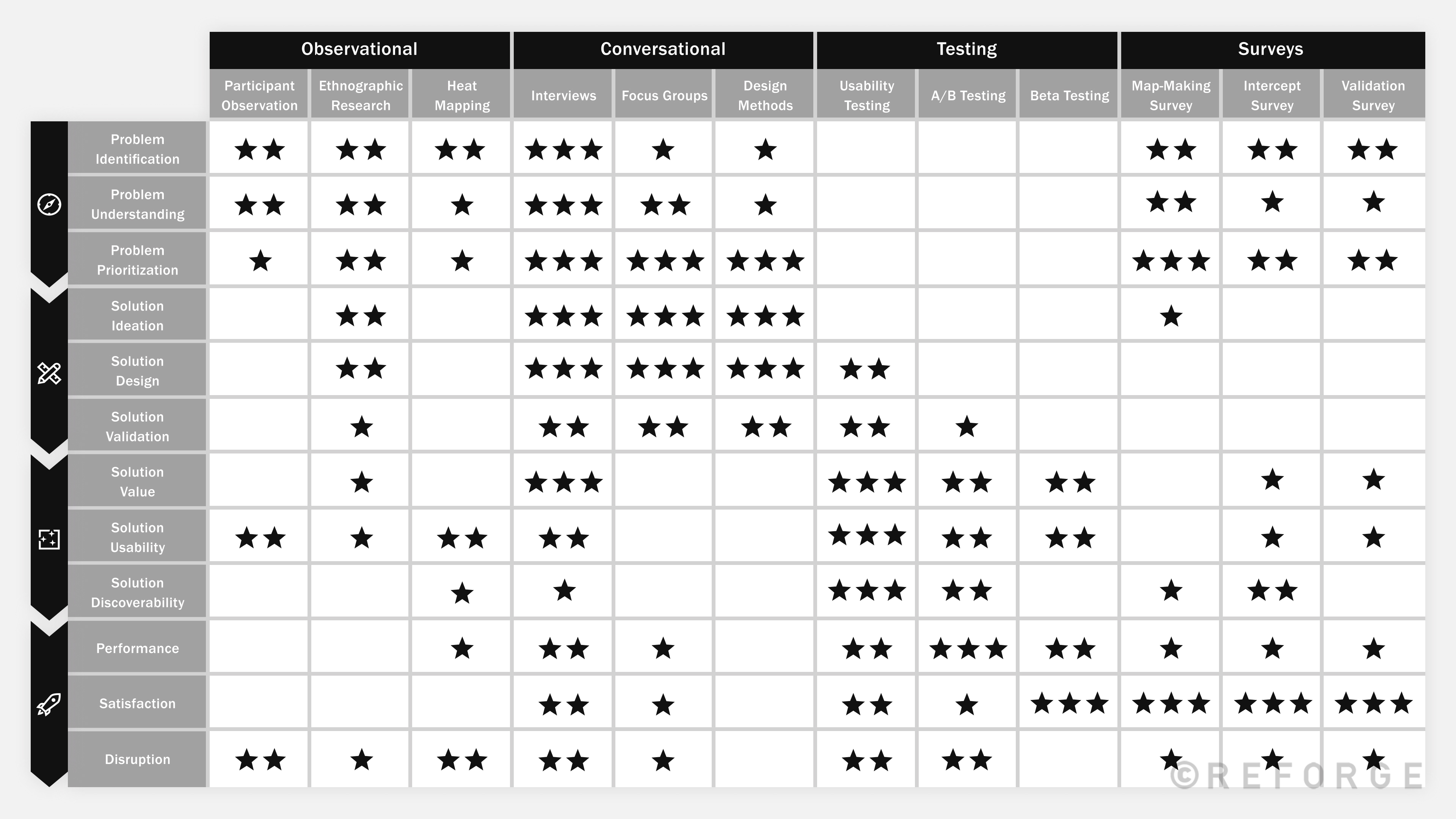
- Observational → Discovery
- Conversational → Discovery/Design/Deploy
- Interviews → All
- Testing → Develop/Deploy
- Surveys → Discover/Deploy
- Qual-Quant Complement
- Hypothesis-Validation
- Moves from WHY to WHAT to HOW
- Mistake: Jumping to WHAT and HOW
-
building your research plan, there are three steps to implement:
- Identify which methods have the strongest fit within your evidence needs
- Identify which methods can create evidence for multiple evidence needs at a time
- Filter out any methods that are tactically infeasible for your situation.
- Common reasons
-
- Mapping Outputs to Methods. Finally, we'll talk through the outputs commonly used to communicate the evidence.
- two pieces:
- The artifact that the research will create: This is the final output of your research efforts and will summarize your findings.
- And the "million-dollar slide": The single slide or chart that you expect to be the key influence to your decision.
- some examples of what different artifacts and million-dollar-slides different research methods can create
- important to brainstorm what you think the research artifact will be and what possible million-dollar slides you could create.
- The last step of this lesson is to describe what artifact your research will be able to create, and to develop a hypothesis of what a million-dollar slide for each research method could look like. This will help ensure you understand what you are working towards before you begin your research.
- two pieces:
- Mapping Decision Stage to Evidence Needs. First, we'll look at key evidence to create with your research, based on your stage of development on the decision matrix
-
Step #5: Research Fidelity
-
Step #6: Research Design Choices